Videoby Falla · TikTok
Hardware · build
Flex a forearm, grab a cube: EMG-controlled myCobot
A dry-electrode EMG band on your forearm opens and closes a myCobot 280 gripper, with no PC in the loop. One Arduino UNO R4 WiFi does all the signal work.
Can I build this?Intermediate · AI 4/5 · $450–600
- Difficulty
- Intermediate
- AI-buildability
- 4/5
- Time
- A weekend
- Cost
- $450–600
Most of the work is firmware (sampling, notch filtering, baseline tracking, serial gripper commands) that AI can write, while the wiring, soldering and electrode placement are hands-on but light.
Parts
Tools
soldering ironjumper wiresArduino IDE
Starter prompt
Based on "Flex a forearm, grab a cube: EMG-controlled myCobot" on Afterware: https://afterware.xyz/p/flex-a-forearm-grab-a-cube-emg-controlled-mycobot
Write Arduino UNO R4 WiFi firmware that reads a dry-electrode EMG module on analog pin A0 at 1,000 Hz. Apply a notch filter for 50/60 Hz mains hum, track a resting baseline automatically, and map clench strength to a 12×8 LED matrix bar. When the signal crosses a threshold, send a gripper close or open command over Serial1 to a myCobot 280.
Estimates based on the original write-up. How AI-buildability is scored. Building with an AI assistant? Connect it to Afterware (free MCP server).
Story
Clench your fist and the gripper closes on the cube. Relax and it opens. The sensor is a dry-electrode surface EMG module strapped to the inner forearm over the finger flexor muscles, and it feeds a single Arduino UNO R4 WiFi that samples at 1,000 Hz, filters out mains hum with a 13-stage digital filter, and tracks your resting baseline automatically.
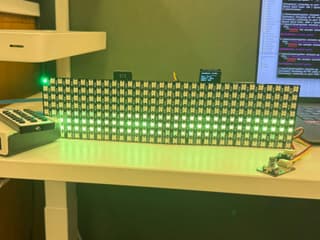
The board's built-in 12×8 LED matrix doubles as a live clench meter. Wiring runs over hardware serial to the myCobot 280 base, and the firmware sends gripper commands straight to the arm. One detail matters: TX goes to TX and RX to RX, because the myCobot base already crosses the lines internally. Power is the other trap. Unplug the laptop charger so the laptop runs on battery, or the switching noise swamps the muscle signal.
Worth stealing: the signal chain is all firmware. Raw sensor output with your own filters beats an envelope module when you need to reject interference, and the LED matrix gives you a free debug display while you tune the strap.
Featured in
Can you vibe code a robot?More like this


More like this