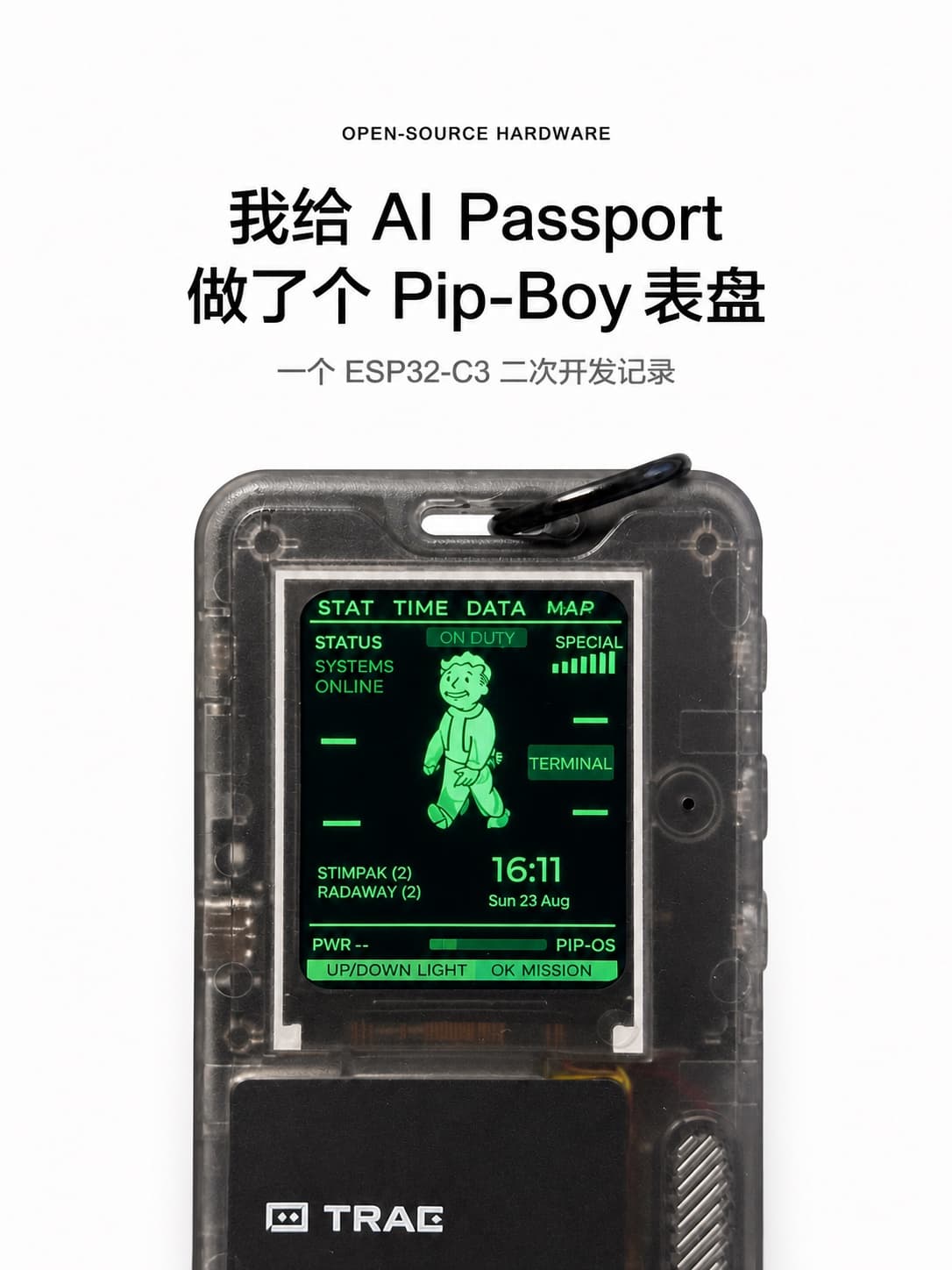
 Interfaceby ricroad · GitHub · LVGL
Interface · mod
Liquid Glass UI running on AI Passport ESP32-C3
An eight-scene interface showcase for the FoloToy AI Passport, a 240×320 ESP32-C3 device with three buttons. It fits translucent glass surfaces, motion and mobile-style navigation into tight memory limits.
Build sheet
- Device page
- AI Passport →
- Base
- FoloToy AI Passport
- Controller
- ESP32-C3
- Framework
- ESP-IDF 5.5.3 + LVGL
- Input
- 3 physical buttons
Can I build this?Beginner · AI 4/5 · $20–40
- Difficulty
- Beginner
- AI-buildability
- 4/5
- Time
- A weekend
- Cost
- $20–40
It's almost entirely firmware for an off-the-shelf device, but tight memory limits and on-device rendering tuning need real iteration and testing on the hardware.
Tools
USB cablecomputer with ESP-IDF 5.5.3
Starter prompt
Based on "Liquid Glass UI running on AI Passport ESP32-C3" on Afterware: https://afterware.xyz/p/liquid-glass-ui-running-on-ai-passport-esp32-c3
I have an ESP32-C3 device with a 240×320 display and three buttons (UP, DOWN, OK). Using ESP-IDF 5.5.3 and LVGL, help me build a small multi-page UI with a focus ring that moves with DOWN, a page change with UP, and a select action with OK. Keep memory use low, with no PSRAM and 8 MB flash, and add a simple glass-style translucent panel over a background image.
Estimates based on the original write-up. How AI-buildability is scored. The maker built this with AI tools: more vibe-coded builds. Building with an AI assistant? Connect it to Afterware (free MCP server).
Story
The project is a firmware replacement for the AI Passport built on the open-source FoloToy template. Eight scenes (Player, Home, Focus, Controls, Devices, Activity, Moments, Appearance) run on the 240×320 display and are driven by three physical buttons: UP moves to the next page, DOWN moves focus, and OK runs the focused action.
The main interest is the rendering. Glass surfaces keep wallpaper detail instead of turning into opaque cards. Focus, toggles, sliders and menu morphing use deterministic non-linear motion. The compositor is RGB565 with a bounded dirty-region planner, written to avoid allocations on a chip with 8 MB flash and no PSRAM.
The repository includes accessibility profiles (High Contrast, Reduce Glass, Reduce Motion), a host-testable motion and optics layer separate from ESP-IDF and LVGL, and a script that captures screenshots over USB Serial/JTAG. The README says the code was written with AI coding tools, and the repo includes AGENTS.md and CLAUDE.md.</story> <parameter name="creator">EnglandLobster
Resources · 2
More like this
More like this
Interfaceby ricroad · GitHub · LVGL